Mobile App Gamification: Examples from Dodo Pizza
The Three Questions Every Game Has to Pass Before It Makes It Into Dodo Pizza’s App
Dodo Pizza’s app has a mini-game where you stack a tower out of pizza boxes after checkout and get paid in dodocoins for it. The brand also builds full promo campaigns around dice rolls, quests, and guaranteed prizes. Gamification clearly has a real place in the app — but behind it sits a bigger question about what actually makes a wow experience for the customer.
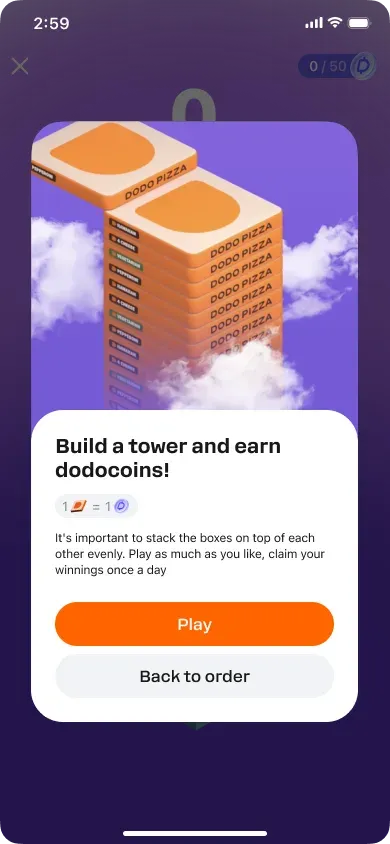
Dodo Pizza box tower gamification in the mobile app
In this piece, Diana Shaimukhametova, CVM Product Owner (Acquisition, Loyalty, Gamification) at Dodo Pizza, explains why games exist in the app at all, how the team decides which mechanic earns a spot, and why they matter for more than just Gen Z.
Games aren’t the strategy
Dodo isn’t trying to turn a food delivery app into a gaming platform. We use game principles wherever they make an order clearer, more emotional, or more interesting. For us, gamification is one tool for building a wow experience.
The app’s first job is to be convenient, clear, and fast — a person should be able to pick their food, place an order, and get it without any extra effort. But functional convenience alone isn’t enough to stand out anymore. A delivery app doesn’t just compete with other restaurants and aggregators. It competes with every digital product out there for a limited slice of someone’s attention.
So the task after building a convenient experience is to make it emotionally appealing, and sometimes unexpected. We call that a wow experience. Gamification is one way to build it, alongside animations, unusual ways of presenting information, and other emotional details.
That said, I wouldn’t say a standalone game has become mandatory for every app. Users don’t have infinite time to play every game brands stuff into their products. If a service adds a mini-game with no clear reason behind it, that doesn’t automatically make the app more interesting. If anything, that kind of mechanic can pull attention away from the main task and add noise nobody asked for.
What’s actually becoming the baseline
The baseline isn’t games as a separate section anymore. It’s the broader use of game principles:
- clear progress
- achievable goals
- immediate feedback
- small rewards
- a sense of completion
- an emotional response from the interface to what the user does Take the progress bar — the simplest piece of gamification there is. It lets someone see, at a glance, how much more they need to add to the cart to unlock a benefit. Call it a game pattern if you want. But first and foremost, it’s just a good way to visualize information and make a decision easier.
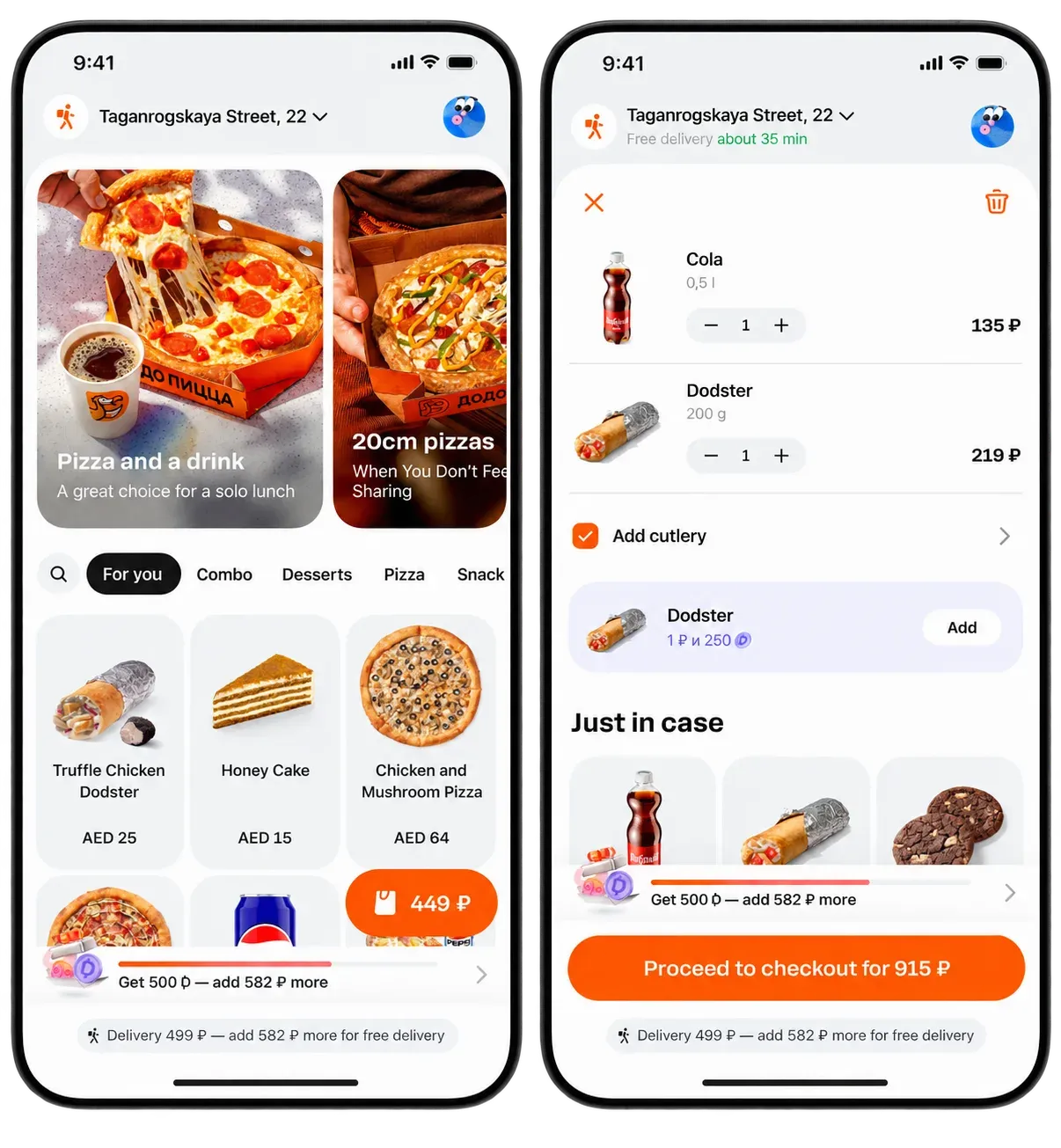
Progress bar gamification in the Dodo Pizza mobile app
Games and game mechanics don’t exist for their own sake, either. They only make sense when they do at least one of three things:
- make an ordinary action simpler and clearer
- boost motivation to do something useful for both the user and the business
- add emotion to a moment that would otherwise be neutral, or even unpleasant, in a regular interface
A game alone isn’t a competitive advantage
Just having a game doesn’t give you an edge. Almost any mechanic can be copied. The advantage shows up when game elements are woven into a brand’s own user experience.
A restaurant’s own app has far more room to work with here than an aggregator does. Aggregators have to represent hundreds of restaurants equally, so they optimize first for universality, breadth of choice, and how fast people can compare options. A brand’s own app can build something more coherent between the user and that specific brand:
- tie the game directly to the order and delivery
- run its own loyalty program
- carry a storyline from one purchase to the next
- create a distinct visual language
- launch mechanics tied to specific products and promo campaigns
- own the entire experience, from picking a pizza to the moment the courier shows up
So the competitive advantage was never the game. It’s the ability to build a consistent, recognizable brand experience — one that’s much harder for an aggregator to reproduce.
And gamification doesn’t replace a product’s basic strengths, either. If the app is clunky, delivery is slow, or the offer just isn’t competitive, no mini-game is going to fix that.
There’s no universal gamification metric
Gamification has to be designed around a specific user problem, not a generic KPI. Sometimes the job is helping someone understand an offer faster. Sometimes it’s motivating them to try something new. Sometimes it’s making the wait for an order less annoying. Sometimes it’s showing progress toward a reward. And sometimes it’s getting people more engaged with the loyalty program.
Retention and order frequency can become a long-term result, but they rarely should be the direct, standalone KPI of a specific game. Too many other factors sit between launching a mechanic and any actual shift in order frequency — price, product quality, delivery speed, range, seasonality, communications.
Is this just a Gen Z thing? Not really.
Millennials and Gen Z genuinely grew up in a digital environment full of personalization, instant feedback, levels, achievement streaks, and progress bars. Those interface patterns feel familiar to them — nobody has to explain the rules.
But it would be an oversimplification to call gamification a purely generational thing. Clear progress, a small reward, a sense of achievement — none of that is exclusive to a young audience. These mechanics tap into much more universal behavior: it’s simply easier to move toward a visible goal, we all value clear feedback, and we all respond well to finishing something.
The generational gap isn’t really about needing a game. It’s about expectations for digital quality. A younger audience notices faster when an interface feels static, impersonal, or outdated — but that doesn’t mean they want a game in every app. They spot forced, meaningless gamification just as fast.
The four layers of Dodo’s game mechanics
We work with several layers of game and emotional mechanics, starting with the simplest.
Progress and goal visualization. A progress bar lets someone see instantly how close they are to a specific benefit — how much more to add to the cart, how many tasks are left before a reward. It’s a familiar pattern that needs almost no explanation. It solves a functional problem, making information easier to read, while making progress toward the goal feel more real.
Animations and emotional feedback. Not every game mechanic reads as a game. Sometimes it’s just an extra animation after an action, or an unexpected reaction from the interface. Details like that don’t change the core task. But they give the sense that the product is responding to what you’re doing, and they make an ordinary process feel a bit more pleasant.
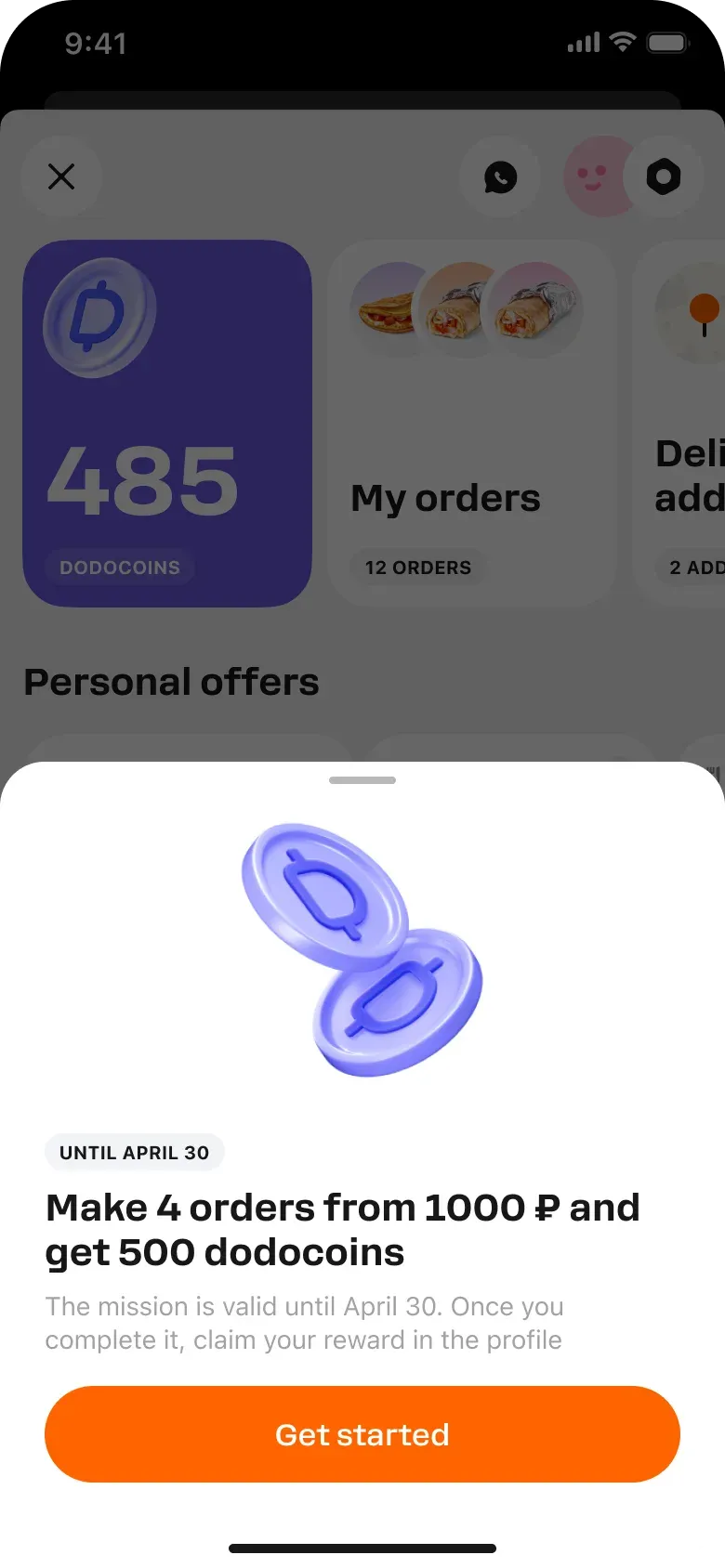
Games inside big promo campaigns. For some of our bigger campaigns, we build a separate game layer on top. Someone might roll a dice, complete tasks, play through mini-games, collect guaranteed gifts, and enter a prize draw. The point is to turn a complicated promo offer into something clearer and more emotional. Instead of a blunt “buy more” or “add these specific items for a discount,” the person sees a goal, a set of actions, progress, and a reward. The game becomes a way to nudge people toward placing an extra order, mixing up their usual cart, trying something new, getting to know a product or offer, or completing several actions within one campaign. Projects like this take real resources, which is why large-scale game campaigns don’t run constantly, or in every market.
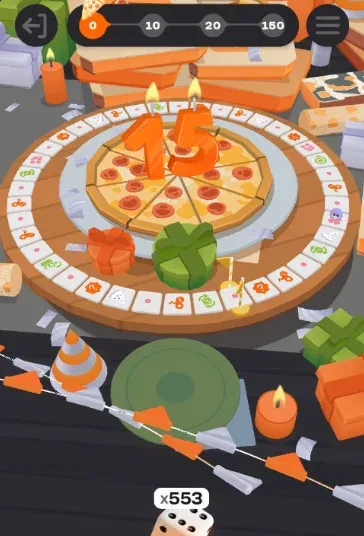
Gamification example from Dodo Pizza’s 2026 Mnogoprizov promo campaign in the mobile app
The pizza box tower. After checkout, a user can stack a tower out of pizza boxes and get paid in dodocoins, Dodo’s in-app loyalty currency. The game started as a hackathon project built to solve three problems: making the wait after ordering less annoying, pulling people into the loyalty program (playing earns dodocoins, so users get introduced to the currency and start banking future value), and adding an emotional beat to what’s otherwise a purely rational ordering flow.
The game drove a real, visible jump in loyalty program use after it launched. Over time, though, that effect flattened out. Today the mechanic supports the user experience more than it drives extra business growth — and that’s a completely normal lifecycle for a product mechanic. Novelty fades, and what once changed behavior turns into just another familiar part of the product.
How we decide what makes the cut
We don’t start with “what game should we build.” We start with “what user or business problem needs solving.”
A good mechanic has to hold up against a few questions:
- What specific user behavior are we trying to change?
- Why would someone want to take part?
- Can they get the rules without a long explanation?
- Is it connected to the app’s core scenario?
- Does it give value to the user, not just the business?
- Does it make the path to ordering more complicated?
- How will we know we got a real increment, and didn’t just reshuffle behavior that already existed? We lean on familiar patterns — progress, a map, a dice, tasks, accumulation, guaranteed rewards. People already know how these work, so nobody has to learn a new interface for a promo campaign that’ll be gone in a few weeks.
What changes first — and what doesn’t count as success
It depends entirely on how the specific mechanic is built. Entering a game doesn’t automatically mean someone will order more often. What usually shifts first is behavior in the moment:
- spends more time on a particular screen
- understands an offer’s terms better
- completes a specific task more often
- adds the product we wanted them to add
- uses the loyalty program more actively
- comes back to check their progress
- gets less annoyed during the wait Only after that can you check whether the local effect turned into something that actually matters to the business — extra orders, higher order frequency, a changed cart, longer-term retention.
It’s important to separate engagement with a game from an actual increment for the business. Someone can play constantly and still buy exactly what they would have bought anyway. So participant counts, game sessions, or time spent playing can’t be treated as proof of success on their own.
Successful gamification isn’t the kind people play a lot. It’s the kind that shifts real behavior without hurting the core experience or the underlying economics.
The bottom line
The best gamification is the kind a user never clocks as a game bolted onto the app. It just naturally continues the main scenario, helps someone get where they’re going, and leaves a bit more good feeling behind after an ordinary action.
Author

Diana Dal
CVM Product Owner (Acquisition, Loyalty, Gamification)