Foodservice Market Maturity: Saturation Signs & Growth Indicators

Foodservice Market Maturity: Key Indicators of Saturation and Sustainable Growth
Across global foodservice markets, a familiar pattern emerges: new concepts open rapidly, competition intensifies, and costs increase. At the same time, large chains continue to scale, and the total number of restaurants worldwide keeps rising.
To navigate risk and still identify real opportunities, operators and investors need a clear framework for interpreting foodservice market maturity signals—understanding whether a market is simply mature or already structurally saturated.
What Defines a Mature Foodservice Market?
A mature market is one where:
- Most accessible food demand for eating out is already served.
- Sales continue to grow but at a slower rate and with higher volatility.
- New restaurant locations tend to redistribute demand rather than expand it.
- Competitive advantage shifts toward operational excellence, customer experience, and efficiency. Global CAGR trends often appear stable, but this macro view hides local fragmentation. Some cities expand rapidly; others operate at a late stage of maturity with rising occupancy costs and tighter margins.
Characteristics of mature markets include:
- High density of restaurants, cafés, bars, QSR, and fast-casual formats
- Strong presence of chain brands alongside resilient independent operators
- Cost pressures that narrow unit-level profitability
Maturity vs. Saturation
Before evaluating specific indicators, it’s important to distinguish between a healthy mature market and one that is structurally saturated.
Market Maturity
Growth slows and competition increases, but well-run operators can still deliver strong returns. Differentiation and execution matter more.
Market Saturation
Capacity exceeds demand. Margins shrink, promotional pressure rises, and failure rates become structurally higher.
Understanding where a market sits on this spectrum is essential for shaping sustainable expansion.
Indicators of a Saturated Restaurant Market
Declining Unit Economics and More Closures
A consistent decline in unit-level profitability—even with competent execution—is one of the clearest signals of structural saturation. This often shows up as shrinking operating margins, higher closure rates, and greater reliance on hyper-precise location selection.
Menu Price Resistance and Slowing Innovation
Menu behavior is an early indicator of market maturity:
- Price increases face resistance.
- Discounts and bundles become essential to maintain volume.
- Innovation slows; new items are incremental rather than transformative. When too many operators offer similar foodservice products, differentiation must shift to service, experience, and brand clarity.
Location Density: When It Signals Saturation—and When It Doesn’t
High outlet density can indicate a vibrant dining scene—or an oversaturated market.
Density becomes a saturation signal when:
- Multiple similar concepts cluster too closely.
- Tenant turnover accelerates.
- New developments over-index in high-risk segments. Density is not inherently negative.
Some districts can support high foodservice business counts when capacity aligns with local spending and demand signals.
QSR-Specific Maturity Signals
Slowing New Unit Development
As markets mature, white space shrinks. Real-estate evaluations become more data-driven, and franchise managers focus on maintaining system profitability rather than pursuing rapid growth.
Flat or Declining Same-Store Metrics
When many major QSR players see soft or negative traffic despite promotions, the market is likely saturated, not just temporarily weak.
Digital Saturation: Oversupply of Virtual Brands
Virtual brands and ghost kitchen formats add capacity that isn’t visible at street level. Digital oversaturated environments increase discount pressure and reduce delivery profitability for both independent and chain operators.
Chains vs. Independents in Mature Markets
Why Chains Gain Share
Chains tend to outperform in mature markets due to:
- Better data and analysis
- Purchasing scale
- Standardized operations
- Strong brand familiarity
Independent Operator Challenges
Independent operators face greater sensitivity to costs, labor, and marketing. Those who succeed win through positioning, relevance, and operational agility.
How to Measure Market Maturity
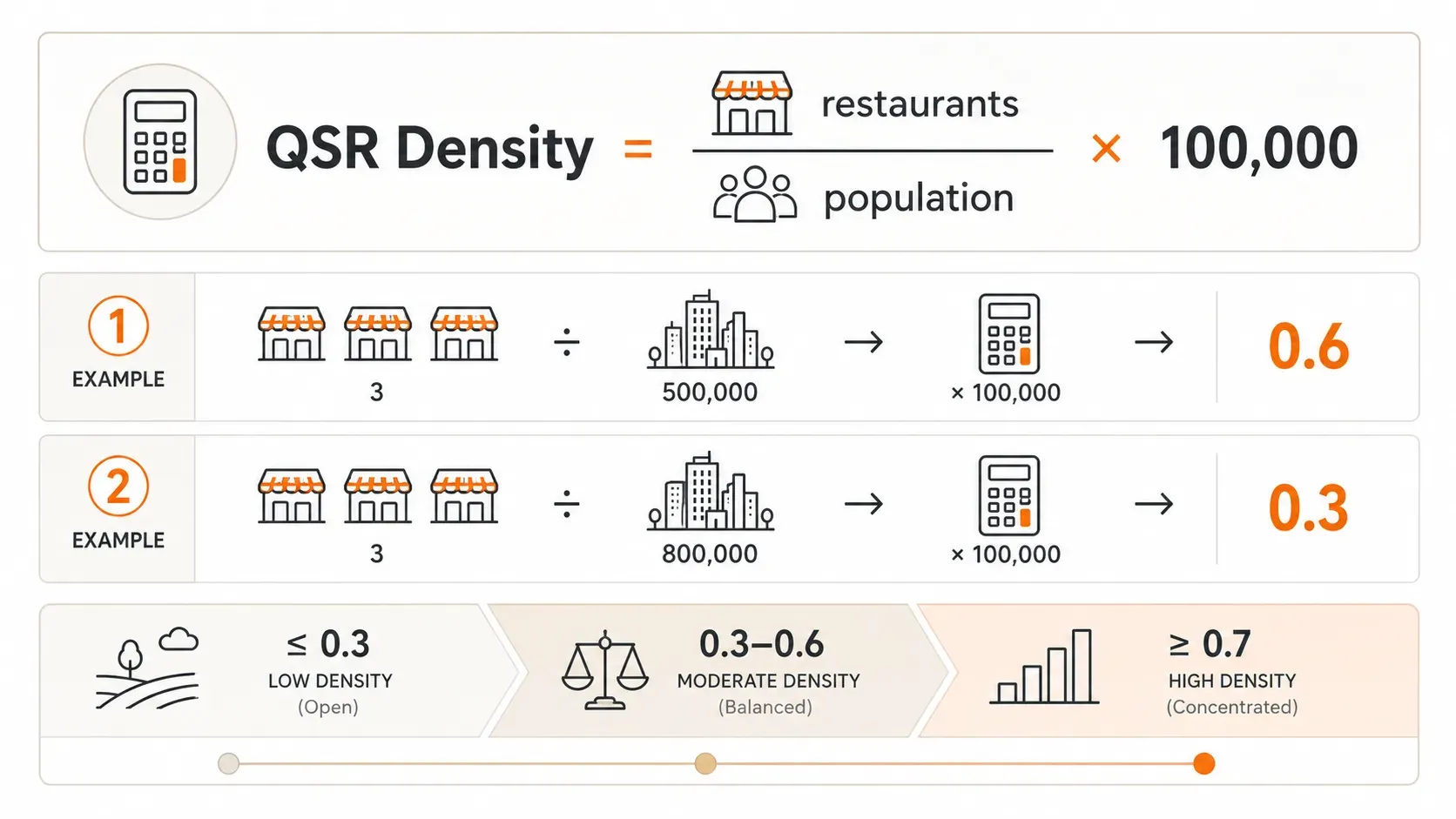
A fast way to understand whether a market is saturated or still has growth potential is to use QSR Density.
The QSR Density Formula
One of the ways to understand whether a market is saturated or still has room for growth is by looking at QSR Density.
QSR Density = number of restaurants per 100,000 people
This metric helps identify signs of saturation and opportunities for new growth.
Example: 3 restaurants in a city of 500,000 → 0.6 3 in a city of 800,000 → 0.3
How to Interpret It
- ≤ 0.3 → likely white space
- 0.3–0.6 → balanced
- ≥ 0.7 → oversaturated; growth requires strong differentiation
At Dodo Brands, we always analyze a market before entering it. As part of this process, we conduct multiple studies, including market saturation research, to better understand demand, competition, and long-term growth potential.
Run the Numbers on Your City
If density is low, the market likely still has room to grow.
Conclusion: Mature Markets Still Offer Opportunity
A mature or saturated market does not eliminate opportunity. It shifts growth limits and increases the importance of:
- clear positioning
- operational discipline
- sharper analysis
- better data
- creative marketing Even in saturated environments, strong brands can outperform. Dodo Brands proved this with its large-scale Genshin Impact collaboration—a bold industry example of how culturally relevant marketing can drive sales and attract new audiences even when the overall market stagnates.
In high-density, competitive foodservice environments, operators win not by adding more restaurants but by outperforming within existing capacity.
Author

Marina Monchenko
Researcher